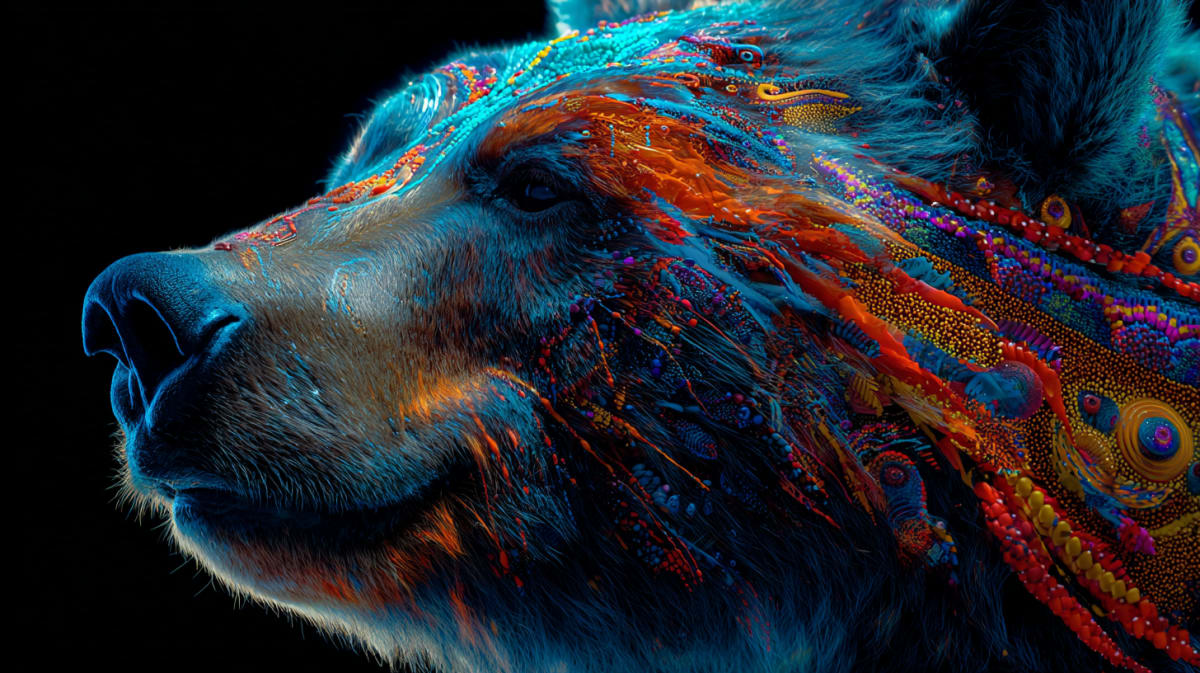
Dream About a Bear — It's Not a Threat, a Power Symbol, or Your Spirit Animal. It's a Strong Mental Habit That's Been Running Your Life Without Your Permission.
So you woke up from a dream of a bear — chasing you, standing in your kitchen, watching from the trees, blocking your path. Every dream site says danger, strength, motherhood, or 'spirit animal.' All wrong. Here's what your subconscious is actually showing you — a precise diagnostic of which dominant mental habit has been quietly running your daily life on autopilot.
So you woke up from a dream of a bear. Maybe it was at the edge of a forest, maybe it walked into your house, maybe it was chasing you, maybe it was just standing there watching you, maybe it was a mama bear with cubs, maybe you were trying to make yourself look bigger and back away slowly. Every dream site you Google will tell you the same things. Bear means danger. Bear means strength. Bear means your spirit animal. Bear means motherhood, protection, the divine feminine, the wild, your shadow self. Read those a second time. Notice how all of them are vague enough to mean anything and specific enough to tell you nothing.
Here's what's actually happening at the level of mind. In the Universal Language of Mind — the symbolic language your subconscious uses every single night — animals represent your mental habits. Habitual thoughts. Patterns of mind that run on autopilot. And the bear, of all the animals your subconscious could've picked, is one of the strongest. The bear is a strong, dominant mental habit that's been running your life. Not a vague "shadow." Not a "warning." A specific, identifiable habit of mind that you've been letting run things. That's the dream. That's the read.
So why do animals always mean mental habits in the ULM
Think about what an animal actually is. An animal lives by instinct. It does the same things over and over, mostly without thinking. It eats, it moves, it reacts, it sleeps, all on patterns it didn't choose. That's the form. The function is automatic, repetitive behavior that runs without consciousness.
Now think about what a habit is in your life. A habit is a pattern of thought or behavior that runs on autopilot. You don't decide to think the same anxious thought every time your phone buzzes — you just do. You don't decide to scroll, to react, to assume, to defend. The habit just runs. That's also automatic, repetitive behavior that runs without consciousness.
So in the symbolic language of your subconscious, animals = mental habits. Form and function lock together. And the type of animal tells you the size and force of the habit. A bee is a tiny habit you barely notice. A cat or a dog is a regular daily habit. A horse or elephant is willpower (special meanings). A snake is your creative energy itself (special). And a bear is one of the heaviest, most dominant habits in your inner ecosystem. The kind of habit that, when it shows up in a room, the whole room reorganizes around it.
So what kind of habit, specifically? Read the bear's behavior
The bear's behavior in the dream is the behavior of the habit in your waking life. This is where the dream stops being abstract and starts being a forensic report on your own mind. The subconscious doesn't just send "a bear" — it sends a specific bear doing a specific thing in a specific place. Every detail is the dream telling you what kind of habit and how it's currently operating.
A bear chasing you
So the bear is chasing you and you're running. This says there's a strong mental habit you've been running from in your waking life. Not avoiding casually. Actively trying to outrun. Could be a habit of self-criticism, a pattern of comparison, a spiral you keep ducking, an obligation you keep dodging. The chase isn't the problem. The chase is the dream telling you that you've been running and the habit is faster than you. Bears in waking life can outrun humans. Habits in waking life always outrun avoidance.
A bear standing in your house
The house in ULM is your state of mind. So a bear in your house is a strong mental habit that's now living inside your everyday state of mind. Not visiting. Living. It's gotten so comfortable in your daily experience that it's just there now, the way furniture is just there. You've stopped noticing it. The dream is making you notice it.
A bear watching you from a distance
This is the dream telling you a strong habit has surfaced into your awareness but you haven't engaged with it yet. You see it. It sees you. Nobody's moving. This is the moment right before the conscious mind decides what to do with the habit. Look at it, walk toward it, walk away, or pretend you didn't see it. The dream is asking you to notice that the choice is right there.
A mama bear with cubs
The mama bear is a strong habit that's actively producing more habits — the cubs. One pattern of mind has spawned a whole family of related smaller patterns. The classic example is a single core belief (the mama) that has generated a dozen related behaviors (the cubs). The dream is showing you the lineage. If you address the mama, the cubs lose their mother. If you only address the cubs, the mama keeps making more.
An attacking or aggressive bear
The habit is currently aggressive — actively interfering with your daily life, breaking through your attempts to control it, demanding attention. Aggressive bear dreams almost always show up when a long-suppressed pattern is breaking the seal. Your subconscious is escalating because the polite versions of the message didn't land.
A calm or sleeping bear
The strong habit is dormant. It's in your inner environment, but it's not currently active. Sleeping bear dreams often show up when someone's done conscious work to settle a pattern but hasn't fully integrated it. The bear didn't leave. It went to sleep. So the question becomes whether to let it sleep, wake it up to look at it, or relocate it.
A bear blocking your path
A specific strong habit is in the way of where you're trying to go in waking life. You can't proceed without dealing with it. This is the dream that shows up when someone's trying to move forward in some area of life — career, relationship, health, creative work — and a long-standing pattern is the actual obstacle, not the external circumstances they keep blaming. The bear isn't random. The bear is exactly on your path.
A bear you're feeding or befriending
This is the most quietly important variation. You're feeding a strong habit. You're voluntarily strengthening a pattern. This dream usually means you've made a habit comfortable enough that it now expects to be fed by you. Befriending a bear in dream usually means you've identified the habit and are starting to consciously work with it instead of running from it — a much more advanced relationship.

Bindu says: "The bear isn't dangerous because it's a bear. It's dangerous because you've been pretending it's not in the room. Look directly at the habit and the bear shrinks."
So what kind of bear matters too
The kind of bear specifies the flavor of the habit. A grizzly bear is a habit with a temper — usually a reactive, anger-flavored pattern. A polar bear is a habit that operates in a cold, isolating part of your life. A black bear is the most generic strong habit — the average dominant pattern. A teddy bear is a childhood habit you've kept around for comfort, even though it's no longer protecting you. A panda is a habit you find harmless or even cute that's actually still taking up significant inner space.
The location matters in the same way. A bear in a forest is a habit running in a part of your subconscious that you don't usually visit. A bear in your kitchen is a habit operating around how you process and digest knowledge from life experiences. A bear in your bedroom is a habit that activates when you're trying to rest and assimilate. A bear in your car is a habit running on the way you direct your physical body and life. The setting tells you where the habit is alive in your mind.
Stop guessing what your bear dream is pointing at
CHITTA decodes every element in your dream — the bear, its behavior, the location, your action, all of it — using the same ULM framework laid out here. One dream in. One precise reading of which mental habit your subconscious is showing you out.
Decode Your Bear Dream Now →The mirror exercise: identify the bear in your waking life right now
So pick the most recent bear dream you remember. Now answer four questions in order. First, what was the bear doing — chasing, watching, sleeping, attacking, blocking, feeding, hugging? Second, where was the bear — your house, the wild, somewhere unfamiliar, on your path? Third, what were you doing — running, freezing, watching, fighting, befriending, ignoring? Fourth, and this is the one most people skip, what is the strongest, most dominant, hardest-to-shake mental habit you have right now in your waking life?
Now hold those four answers next to each other and let your subconscious connect them. The bear's species and behavior describe the size and current state of the habit. Where it is describes where the habit lives in your inner life. What you were doing in the dream is what you're currently doing about that habit in waking life. Most people, when they do this honestly, can name the bear within sixty seconds. The dream isn't being mysterious. It's being painfully direct.
If you can't name a strong habit, that's the dream telling you the habit is so normalized you've stopped seeing it. Ask someone close to you. They can usually name your bear faster than you can.
So why does the same bear keep coming back?
Recurring bear dreams mean the strong mental habit is still active and you haven't engaged with it. The subconscious doesn't stop sending the same dream until the dreamer reads and acts on the message. So if you've been having bear dreams for weeks, months, years, the habit you're being shown is still running your life. The bear in the dream changes form a little — bigger, smaller, closer, farther — as your relationship with the habit shifts in waking life. But the bear keeps showing up until the habit shifts for real.
The good news is that the moment you actually identify the habit, name it out loud, and start consciously reorganizing your waking life around its presence, the bear dream changes. Sometimes it leaves entirely. Sometimes it shows up smaller. Sometimes it becomes calm. The dream is a feedback instrument. It's reflecting your actual progress, not your wishful thinking.
So what do you do with this
You stop treating the bear as an animal in a dream and start treating it as a mirror of one of your strongest mental habits. You name the habit. You watch how it's been running your daily life. You decide whether to keep feeding it, befriend it, relocate it, or let it sleep. And then you let the next bear dream show you whether the relationship moved.
This is the entire mechanic behind why animals show up in dreams in the first place. The dream is a mirror. Animals are habits. The size and force of the animal tells you the size and force of the habit. Once you can read it, you stop being afraid of bears in dreams and start being grateful for them. Your subconscious is showing you exactly what's been running your life on autopilot — and giving you the chance to take the wheel back. Full stop.
Read every animal that's ever shown up in your dreams — through the right lens
CHITTA gives you the ULM meaning of every element in your dream and shows you exactly which mental habits your subconscious has been pointing at. Stop guessing. Start reading.
Decode Your Dream Now →
Frequently Asked Questions


LUCID
You've tried every lucid dreaming technique. Most miss the root cause. LUCID reveals what they all skip.
Understand Your Own Mind
"Structure of the Mind" reveals the three divisions of mind, seven levels of consciousness, and powers of mind that most people never learn to develop.