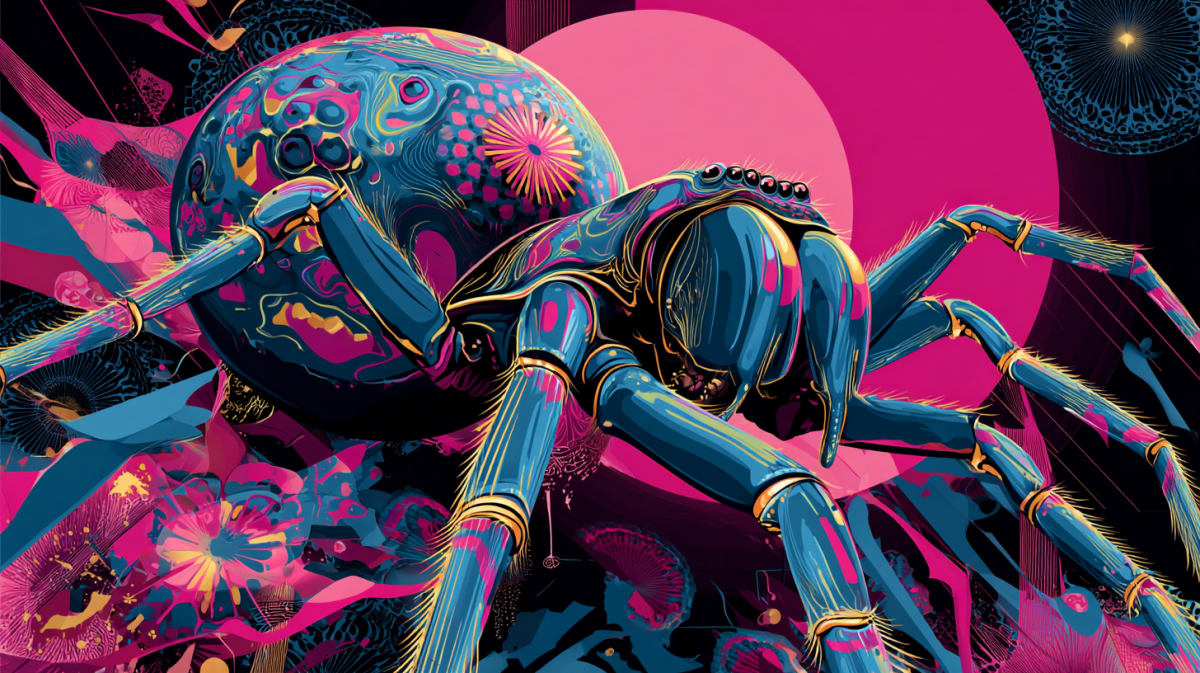
Dream About a Spider Web
The spider is the habit. The web is the trap that habit spins. Your dream is showing you both.
You walk into a room you have walked into a thousand times, and there it is: a spider web stretched across the doorway, catching the light. In the dream you stop. You do not want to touch it, but you cannot quite look away. That hesitation is the whole message. A spider web in a dream is rarely about spiders at all. In the Universal Language of Mind, it is your own inner sight showing you something you built without meaning to build it.
Here is the thing almost nobody tells you about this dream: the web is not a warning about someone else. It is a portrait of a habit. And by the time you finish reading this, you will know exactly which one.
A spider in a dream is a small mental habit — a thought you repeat. The web is the invisible structure that habit spins around your life over time. The dream is showing you the trap you wove yourself, and the fact that you can still walk out of the doorway.
What does a spider web actually mean in a dream?
Let us be precise, because precision is mercy here. In the Universal Language of Mind, every image in a dream is your subconscious speaking to your conscious self in pictures. It does not deal in spiritual omens or luck. It deals in mechanics — the actual machinery of how your mind builds your experience.
So the spider is the maker. It represents a small, repeated mental habit — a thought you think so often you no longer hear yourself thinking it. The web is what that habit produces. Strand by strand, almost invisibly, a single recurring thought spins a structure that begins to catch things: your attention, your energy, your choices. You did not decide to build a web one morning. You built it the way every web gets built — one thread at a time, each thread a repetition of the same small motion.
That is why the dream feels both familiar and faintly unsettling. You recognize the structure. Some part of you knows you made it. Tarak Uday teaches that the dreaming mind never shows you a problem without also showing you your relationship to it — and a web is the perfect image of a trap that was self-spun.
Why is your mind showing you a web instead of just telling you?
Because a habit you can see in words, you can argue with. A habit you can see as a web, you cannot un-see. That is the genius of how your inner mind teaches.
Think about how a real web forms. No single strand is heavy. No single strand traps anything. It is the accumulation — the patient layering of identical motions — that turns thin silk into a structure strong enough to hold. Your repeated thought works exactly the same way. "I always mess this up." "People will leave." "I have to do it all myself." Said once, it is nothing. Said ten thousand times, it becomes architecture. It becomes the room you live inside.
You did not fall into the web. You are the spider. And the spider is never trapped by its own web — it walks the threads freely the moment it remembers they are its own.
So when the dream places a web in front of you, your subconscious is doing something kind. It is taking a process that happens invisibly — thousands of repetitions of a quiet thought — and freezing it into a single image you can stand in front of and finally face.
What is the difference between the spider and the web in your dream?
This distinction changes everything, so sit with it. The spider is the habit in motion — the thought as you are thinking it. The web is the habit's accumulated result — the life-structure that thought has already built.
In the Universal Language of Mind, form and function are the two halves of every symbol. The form is what the image looks like; the function is what it does in your psyche. A web's form is delicate, beautiful, geometric. Its function is to catch and hold whatever moves through that part of your life. So if you dream of being tangled in a web, the function is unmistakable: something you repeatedly think has begun to catch and hold you, slowing your movement in a specific area.
And notice where the web is. A web across a doorway is about transition — a habit catching you every time you try to move forward. A web in a corner you had forgotten is an old pattern, dormant but intact. A web you are actively building in the dream is a habit you are still feeding right now, today, with your repeated attention.
How do you walk out of a web you spun yourself?
Here is where most dream interpretation stops and real transformation begins. You do not destroy a web by fighting it. You have felt this — the harder you struggle against a habit, the more tangled you become. That is not failure. That is physics. Thrashing only weaves more thread.
The spider walks its own web freely because it knows which strands are structural and which are sticky. So your work is the same: not to tear the whole thing down in a panic, but to learn your own pattern well enough to move through it. Ask the dream directly. Which single repeated thought is this web made of? Not the surface story — the one quiet sentence underneath, the one you have repeated so long it sounds like simple truth.
When you remember a dream with a spider or a web, do not let it fade. Bring it to CHITTA and let the Universal Language of Mind show you the exact habit your inner self is mapping — and the doorway it is asking you to walk through.
The moment you name that one thought, the web changes from a trap into a map. Every strand becomes information: here is where this habit reaches, here is what it has been catching, here is the doorway it has been guarding. And a habit you can see clearly is a habit you have already begun to outgrow. The spider in your dream was never your enemy. It was you, showing you the precise shape of what you have been building — and quietly reminding you that the maker is always free to make something else.

Frequently Asked Questions


LUCID
You've tried every lucid dreaming technique. Most miss the root cause. LUCID reveals what they all skip.
Understand Your Own Mind
"Structure of the Mind" reveals the three divisions of mind, seven levels of consciousness, and powers of mind that most people never learn to develop.