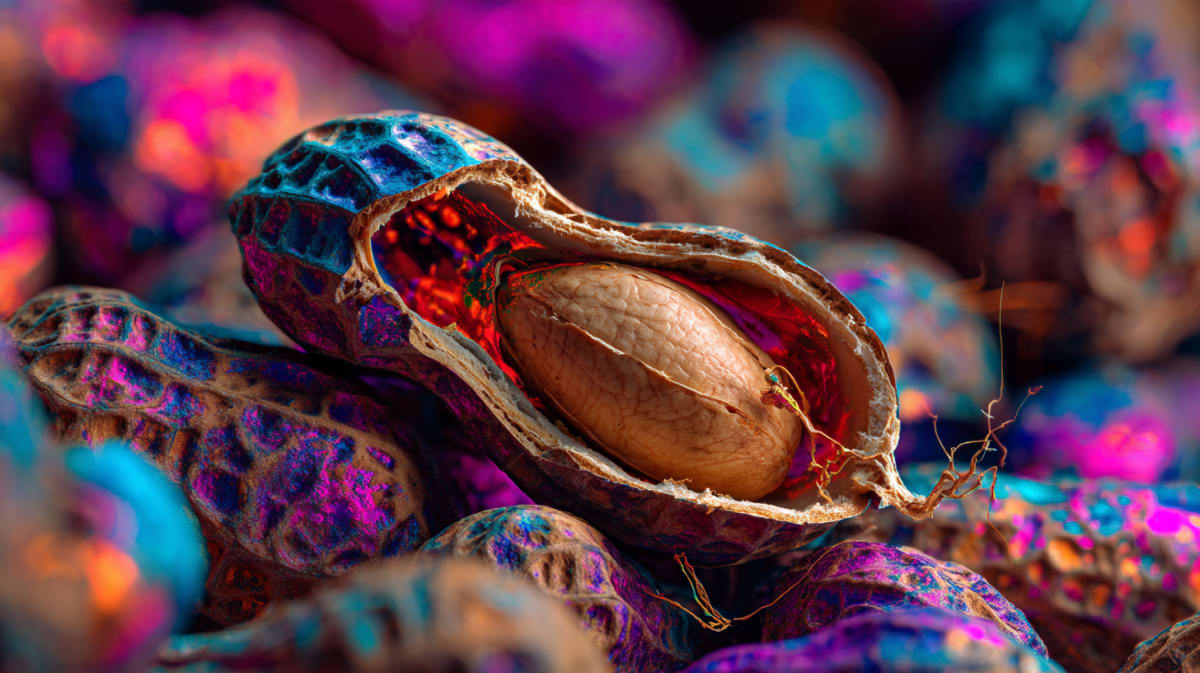
Peanuts in Dreams: The Lesson Still Inside the Shell
A peanut is knowledge sealed in a hard shell, and your dream is asking whether you've cracked it yet.

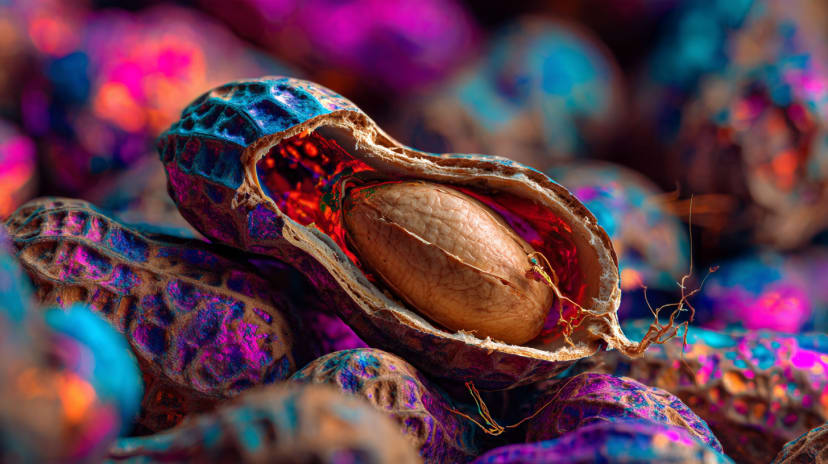
You were holding a peanut, or a whole handful of them, or you were standing in a room with shells crunching under your shoes. Maybe you were cracking one open with your thumbs. Maybe you were eating them without stopping, one after another, and woke up still tasting salt. So the question is a fair one: is a peanut just a snack your brain grabbed from the day, or is it saying something? It's saying something. Peanuts represent knowledge, a lesson sealed in a shell, and the dream is asking whether you've reached the inside of it. Think of the one experience you keep replaying, because that's the one this dream is about.
In the Universal Language of the Mind, food represents knowledge and the process of assimilating your life experiences. A peanut is a seed sealed inside a hard shell, so it represents a lesson that is still wrapped in the experience that produced it. The reading turns on one question: did you get the shell open, and what happened to the kernel once you did?
What does a peanut mean in the Universal Language of the Mind?
The Universal Language of the Mind works on form and function. What a thing does in the physical world is what it does inside your mind, and it means the same thing for every dreamer. So before the peanut, start with the category it belongs to. Food.
Here's the canon in plain terms. Food in a dream represents knowledge, and more precisely the process of assimilating life experiences. Peanuts carry the same gloss, in the dictionary's own words: "Knowledge - The Understandings we build through the life lessons that we learn." So a peanut isn't a symbol of money, or luck, or an allergy. It's a symbol of understanding that you earned by living through something.
Then comes the mechanics, and this is where it gets practical. Your teeth break food down so you can swallow it and your body can digest it and pull out the nutrients. Your life experiences work the same way. When you really break an experience apart and look at its pieces, it becomes easier to swallow. It becomes easier to understand what happened. Then you extract the lesson, feed it into yourself, and make it a permanent part of how you think. And whatever isn't nourishment, you let go of. Tarak Uday teaches this as one continuous process: break down, extract, integrate, release.
Now you know what a food dream is. It's a nudge to look at the knowledge sitting inside your experiences and ask whether you've actually digested it. So where does the peanut fit?
Why does the shell matter more than the peanut?
Because the shell is the thing a peanut has that most foods don't. Bread, soup and fruit arrive ready. A peanut doesn't. It's a small seed locked in a hard casing, and you can't eat it until you crack the casing open with your hands or your teeth.
That's form and function, and it translates directly. The experience is the shell. The lesson is the kernel. Everything that happened to you, the argument, the job you lost, the year that went sideways, arrived as a shell: hard, dry, and nothing you'd call nourishing on its own. The nourishment is inside, and nobody can hand it to you through the shell. You have to do the cracking.
So here's the belief worth flipping. Most of us think a hard experience is the lesson. It isn't. The experience is the packaging. You can carry a shell around for ten years, gripping it, retelling it, even decorating it, and never once eat what's inside. People do this constantly. They hold the story of what happened to them as if the story were the knowledge, and then they wonder why they keep going hungry.
That's why a peanut dream rarely feels dramatic. It's a quiet image with a precise question inside it. Is there something in your life you've been gripping for a long time that you've never actually opened?
What does it mean to crack peanuts, or to find piles of shells?
Cracking is the active version of the dream, and it tells you the work is underway. You're breaking an experience open to get at what's inside. Watch how it felt. If the shell split easily and the kernel was whole, the dream reports that an experience is giving up its lesson without a fight. You're ready to understand it, and that tends to arrive as a calm, almost obvious realization in waking life.
If the shell was stubborn, you were working your thumbs raw or biting down hard, then the dream is describing effort. That experience is still tightly closed and you're putting real force into opening it. That isn't failure. A hard shell protects a seed, and the harder the shell, the more the experience has to teach you. It just means the digesting is going to take longer than you wanted it to.
Now the shells themselves. A pile of empty shells is one of the most informative images in this whole dream, and almost nobody looks at it. Each empty shell is an experience you already opened. The kernel has been eaten. So a heap of shells at your feet reports a body of experience you've already assimilated. You've done more of this work than you give yourself credit for, and the dream is showing you the evidence.
But a pile of unopened peanuts tells a different story. That's lessons gathered and not yet taken in: a bag full of experiences you've collected, kept close, and haven't cracked. It's the person who has been through a lot and processed very little of it. The dream isn't scolding. It's counting.
And here's the detail that decides the reading. Look at what you did with the shells. If you dropped them and walked on, you let go of the experience once you'd taken the lesson, which is exactly what the canon says to do. If you were pocketing the shells, hoarding them, unable to throw them away, you're holding on to experiences you've already learned from. That's the part that turns toxic. The lesson was eaten, but you kept the container.
What if the peanut was rotten, bitter, or you choked on it?
These are the unsettling versions, and they all come back to the same food mechanics.
A rotten or bitter peanut is food that wasn't eaten in time. The canon is direct about this: an experience you don't digest and let go of doesn't just sit there, it becomes toxic to your energy and your well-being, the way a body that can't release waste would. So a spoiled peanut reports a lesson that has gone off because you carried it too long without extracting it. Ask yourself what you've been holding onto past its use-by date. A grudge, a failure, a story about why you can't. It was a perfectly good kernel once.
Choking is a different failure, and it comes from the teeth. Teeth exist to break food down so it can be swallowed. If you choke, something went down that hadn't been broken apart first. So a choking dream describes a lesson you tried to take in whole: you wanted the understanding without doing the chewing. It points to an experience that needs to be dissected, taken in smaller pieces, before it will go down. Notice that it's also a message about pace. You can't swallow a lesson faster than you can break it down.
The same logic covers an allergic reaction to a peanut. Something that's meant to nourish you is being rejected the moment it touches you. In the language of the mind, that's a lesson you have trouble taking in at all, a piece of understanding that your system pushes back against on contact. It doesn't mean the knowledge is bad. It means you haven't found a way to make it digestible yet. If you've dreamed this, think about the truth you keep refusing, and then ask whether it would be easier to take in a bite at a time.
Since a dream about teeth is the sister dream to all of this, it's worth knowing the same mechanism sits behind it. If your peanut dream also had your teeth crumbling, read that as the same question asked twice: how well are you breaking down what happens to you?
What about peanut butter, a bag of peanuts, spilled peanuts or feeding an animal?
Each of these is the same seed, changed by one small variable. So let's take them in order.
Peanut butter is a peanut with the shell already gone and the kernel already broken down. It's knowledge that has been ground into something easy to spread and swallow. So a peanut butter dream often reports a lesson you've already worked through, now ready to be used. Spreading it on something is applying what you learned to a situation. Eating it straight from the jar is taking in understanding you've already prepared, and it asks only that you let it feed you.
A bag of peanuts is a supply. Small units of knowledge, bundled and portable, eaten by the handful. It reports the amount of life experience you have available to learn from right now. A full bag asks what you plan to do with it. An empty bag, with salt in the corners and nothing left, can report a stretch where you've taken in everything on offer and have no new material coming.
Tarak Uday takes this further in Life Is But a Dream, his guide to reading every dream in the Universal Language of the Mind.
Spilled peanuts are lessons scattered before you could use them. The container failed, and the knowledge went everywhere. That can describe a period when too many experiences hit at once, or a moment where you tried to hold more than you could organize. The fix isn't to panic. It's to pick them up one at a time and crack them one at a time.
Feeding peanuts to an animal is the one that surprises people. Food is knowledge, and you're handing it to something else. So the dream is about passing understanding along: sharing what you learned with someone, or feeding a part of yourself that's been starved of it. What kind of animal it was matters, because that's the part of you or the person receiving the lesson. Did it take the peanut gently? Did it ignore it? Their response is the answer.
A note on what not to do with any of these. Don't reach for another nut or legume to explain a peanut. Nuts, beans, corn and food all share one canon meaning, so any difference between them that I handed you would be invented. The only honest differences come from what you can see: a peanut is small, it's in a shell, and you crack it. Everything above is built from those three facts. Our lime article shows the same food mechanics at work on a different fruit, if you want to see the method run again.
How do you use a peanut dream tonight?
Start by naming the shell. Which single experience have you been carrying around closed? Not your life, not a general mood. One thing, with a date on it if you can manage that. A peanut is a small seed, and the dream is small and specific for the same reason.
Then crack it, in writing. Describe what happened as plainly as you can, the way you'd describe a shell: its shape, its hardness, what made it hard to open. Then ask the only question that matters. What did this teach me? Not what it did to me. What it taught. The sentence you write after that question is the kernel, and it's usually shorter than you expected. Most lessons are small.
Then do the part everyone skips. Put the kernel somewhere it will stay. This is where CHITTA earns its place, because a lesson you've extracted but never recorded slips back into a feeling within a week. Your dream journal keeps the dated record of what you dreamed, and the interpretation engine reads your peanut against the symbols around it, so you can see which lesson the dream is pointing at rather than guessing. The symbol dictionary shows you the food family it belongs to, and how the same mechanics run through every other thing you eat in your sleep. Over a few weeks you'll see whether the shells in your dreams are piling up, which means you're digesting, or whether the same unopened bag keeps coming back, which means you aren't.
Write down tonight's dream while it's still sharp and let the symbol dictionary show you what each image is made of. Start your dream journal.
One last thing, because it's the part of the canon that actually frees people. Once you've taken the lesson, let go of the experience itself. You don't owe the shell your attention forever. Gratitude for what it taught you is what makes it easy to put down, and putting it down is how you stop it from turning toxic.
So before you sleep tonight, name the one experience you're still carrying in its shell, and write the lesson inside it in your dream journal.
Frequently Asked Questions



Books by Tarak Uday

Learn The Language Your Dreams Speak
"Life Is But a Dream" teaches the Universal Language of the Mind — how to read any dream symbol by what it is and what it does, so every dream becomes a message you can act on.

LUCID
You've tried every lucid dreaming technique. Most miss the root cause. LUCID reveals what they all skip.
Understand Your Own Mind
"Structure of the Mind" reveals the three divisions of mind, seven levels of consciousness, and powers of mind that most people never learn to develop.