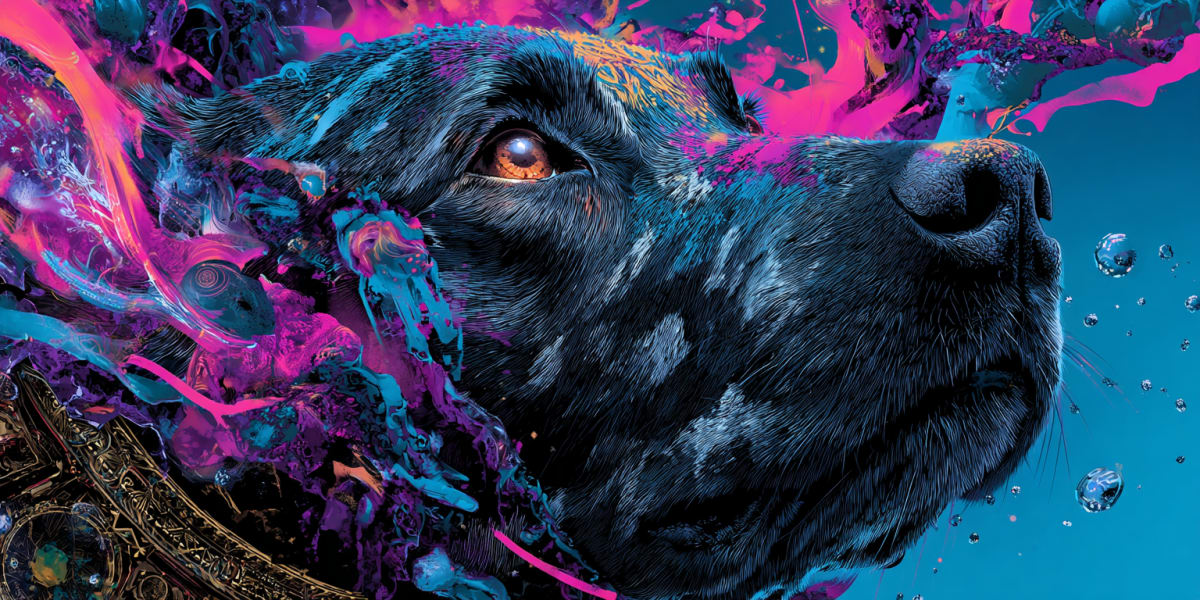
What Does a Black Dog Mean in a Dream
You're somewhere ordinary in the dream — a street you half recognise, a hallway, the edge of a yard — and there's a black dog. It isn't lunging. It isn't barking. It's just there, at the edge of where you can see, and you know exactly what it is without being able to describe a single thing about its face.
Most people take that image to the internet and come back with a verdict: bad omen, or depression, or grief walking beside you. Both readings are inherited, and both point you away from the one thing the dream is actually built to tell you.
A dog in the Universal Language of Mind means a mental habit. The black coat isn't a rating of that habit. It's a description of how much of it you can currently make out.
A dog in a dream is a mental habit. A black dog is a habit running close enough to recognise and not yet clearly enough to name — which is precisely the stage at which it can still be changed.
What does a dog actually mean in the Universal Language of Mind?
Your dreaming mind assigns meaning by behaviour. Whatever a thing does out here is what it stands for in there, which is why the vocabulary holds across cultures and centuries rather than varying by dreamer. Tarak Uday built the entire system of interpretation on that single mechanic, and the dog is one of its cleanest demonstrations.
Consider what a dog does. It is trained once and then repeats the behaviour without deciding to. It answers a trigger rather than a choice — the leash leaves the hook and the animal is already at the door. It is loyal well past the point of usefulness. It follows you home. Once it belongs to you, it stops asking permission to be in your life.
Now describe a habit and notice you've just written the same paragraph. Learned once. Repeats without a decision. Fires on a trigger. Loyal past usefulness. Follows you home. Asks no permission.
So the dog was never an arbitrary stand-in for habitual thought. Your subconscious mind reached for the dog because the dog already behaves the way a habit behaves.
Your subconscious mind didn't choose an animal that represents a habit. It chose the animal that acts like one.
So what is the black coat reporting?
Watch what the colour actually did inside the dream. It removed detail. You registered the shape, the size, the fact that the animal was aware of you. What you could not do was read its face. The dog was entirely present and only partly legible.
That legibility gap is the message. A pattern you have never once noticed doesn't appear at the edge of the yard — it doesn't appear at all. A pattern you've fully examined shows up in daylight detail. The black dog arrives in the narrow window between those two states: the habit has surfaced far enough to be seen as yours, and has not been looked at closely enough to be described.
So the coat is a progress report on your own attention, not a verdict on your character. And that window matters, because a habit becomes workable at exactly the moment it becomes nameable.
Is the black dog depression, the way Churchill meant it?
This is the read worth confronting directly, because it's the one most likely to be sitting in your head already. Winston Churchill used "black dog" as private shorthand for his depressive episodes. The phrase travelled so far that it now functions as a definition, and plenty of people wake from this dream and conclude their mind has just diagnosed them.
Your dreaming mind didn't borrow that phrase. It has never read Churchill's letters. It was using dogs to report habitual thought long before the metaphor existed, and it kept using them in dreamers who've never heard of him.
The practical problem with taking the dream as a diagnosis is that a diagnosis gives you a label and nothing to do with it. "I dreamt the black dog, so I must be depressed" closes the matter. But the dream didn't come to name a condition. It came to show you a repetition.
So run it the other way round. If your mood has genuinely been heavy, the useful question isn't whether the dream confirms it — it's which automatic, unexamined mental habit has been feeding it. That question has an answer you can act on. The label doesn't.
Log tonight's dream in CHITTA and get the Universal Language of Mind interpretation instead of a folklore guess. The dream symbol dictionary will show you what your mind actually said.
Which habit is the dream pointing at?
The dog told you it's a habit. The coat told you it isn't named yet. The rest of the dream narrows it down.
Start with the setting, because places in a dream report states of mind. A black dog outside your home is a habit circling your sense of who you are. One at your workplace sits inside how you earn. One on a road attaches to where you're headed.
Then read the distance. An animal watching from across the yard is a pattern you're aware of and holding at arm's length. One walking at your heel is a pattern you've already accepted as company. One standing in the doorway is a habit positioned directly between you and a direction you were trying to move in.
Then read your own behaviour, because that's the mirror. Did you freeze, call it over, back away, put out a hand? Whatever you did in the dream is what you're doing with the pattern while awake, and the match is usually uncomfortably exact. The dreamer who edged away from the dog is reliably the same person who has been not-quite-addressing the same thing since spring.
One more detail worth catching: whether the animal seemed to be yours. A dog you somehow knew reports a long-standing habit. A stray you'd never seen reports one you've picked up recently — which usually means you can trace it to something that changed in the last few months.
How do you name the habit before it runs again?
Do this the same morning, while the dream is still willing to be honest with you.
Write three lines with no interpretation attached: where the dog was, how close it got, what you did. Then ask a single question. In that area of my life, what do I do automatically that I never actually decided to do? Not what you do badly — what you do without choosing. What surfaces is rarely dramatic. It's reaching for your phone the moment a conversation turns uncomfortable, or saying yes out loud while disagreeing inside, or re-running the same argument in the shower.
Then put it in one plain sentence. That sentence is the whole assignment, because a habit you can state is a habit you can interrupt, and one you can't describe will keep running underneath the conversation you're having about it.
After that, watch for the trigger rather than the behaviour. Habits don't begin when you catch them running; they begin when something pulls the lever. Catching the lever once does more than a fortnight of resolving to do better.
So the dog at the edge of the yard isn't stalking you and it isn't warning you. It's standing exactly where the habit is — close, real, yours, and still unnamed. Your subconscious mind brought it as far into the light as it could. Saying its name is the part that belongs to you.

Frequently Asked Questions




LUCID
You've tried every lucid dreaming technique. Most miss the root cause. LUCID reveals what they all skip.
Understand Your Own Mind
"Structure of the Mind" reveals the three divisions of mind, seven levels of consciousness, and powers of mind that most people never learn to develop.